The Ultimate Guide to Manu and Tambopata, Madre de Dios 2026: Peru's Amazon Rainforest Awaits
The Ultimate Guide to Manu and Tambopata, Madre de Dios 2026: Peru's Amazon Rainforest Awaits
Imagine a sunrise where the jungle's chorus awakens you, with the distant roar of a jaguar, the chatter of howler monkeys, and the vibrant song of exotic birds. Visualize winding rivers carving their way through an infinite green canopy, revealing life in its purest, wildest state. This is the Peruvian Amazon rainforest, a realm of unparalleled biodiversity that invites you on a transformative adventure into the heart of Madre de Dios.
In 2026, Manu National Park and Tambopata National Reserve continue to be invaluable jewels, offering experiences ranging from wildlife observation in their natural habitat to cultural immersion with local communities. Prepare to disconnect from the world and reconnect with nature in one of the planet's richest and most vital ecosystems. This comprehensive guide will provide you with all the necessary information to plan your expedition to the Peruvian jungle, ensuring an unforgettable and responsible experience.
Why Visit Manu National Park and Tambopata National Reserve in 2026?
The Madre de Dios region, in southeastern Peru, is a wildlife sanctuary and a bastion of conservation. Home to two of the world's most important protected areas, Manu National Park and Tambopata National Reserve, it offers a unique window into the majesty of the Peruvian Amazon rainforest.
- Unparalleled Biodiversity: Both areas are famous for harboring an astonishing variety of species. From colorful macaws and toucans to elusive jaguars, giant river otters, various monkey species, and thousands of insects and plants, every corner is a discovery.
- Authentic Experiences: Far from the crowds, here you'll find a deep connection with nature. You'll navigate remote rivers, trek through lush trails, and have the opportunity to observe wildlife in its natural environment, often without human intervention.
- Conservation and Sustainability: By visiting these protected areas, you contribute directly to conservation efforts and the sustainable development of local communities. It's tourism with a purpose, seeking to preserve these treasures for future generations.
- Adventure for Everyone: Whether you're seeking a multi-day expedition deep into the jungle or a more accessible experience with comfortable lodges, Manu and Tambopata offer options for different adventure levels and available time.
Manu National Park: A Sanctuary of Biodiversity
Manu National Park, declared a UNESCO World Heritage Site and Biosphere Reserve, is one of the most biodiverse places on the planet. Its expanse ranges from the high Andean highlands to the lowland Amazon rainforest, creating a variety of ecosystems that host astonishing biological richness.
Key Features:
- Conservation Zones: Manu is divided into three zones:
- Cultural Zone: Accessible for tourism and research, with the presence of native and settler communities.
- Reserved Zone: Designated for research and controlled tourism, with strict regulations to minimize impact. Here you'll find the famous oxbow lakes (cochas) and macaw clay licks.
- Intangible Zone: Exclusively for the protection of indigenous peoples in voluntary isolation and scientific research without intervention. Access is strictly prohibited.
- Emblematic Fauna: It is home to over 1,000 bird species (including the Andean cock-of-the-rock, Peru's national bird), 200 mammal species (monkeys, tapirs, capybaras, giant river otters, and with luck, jaguars), and countless reptiles, amphibians, and insects.
- Access: Access to Manu National Park is more complex and requires specialized logistics, generally by river from Atalaya or Shintuya (Madre de Dios), or by road and river from Cusco, making it a more remote and exclusive experience.
💡 Local Guide Tip: For a complete Manu experience, consider a trip of at least 5 to 7 days. This will allow you to delve into the Reserved Zone and increase your chances of spotting elusive wildlife like giant river otters in the oxbow lakes or even a jaguar. Patience is key in the jungle.
Tambopata National Reserve: Accessible Adventure and Nature
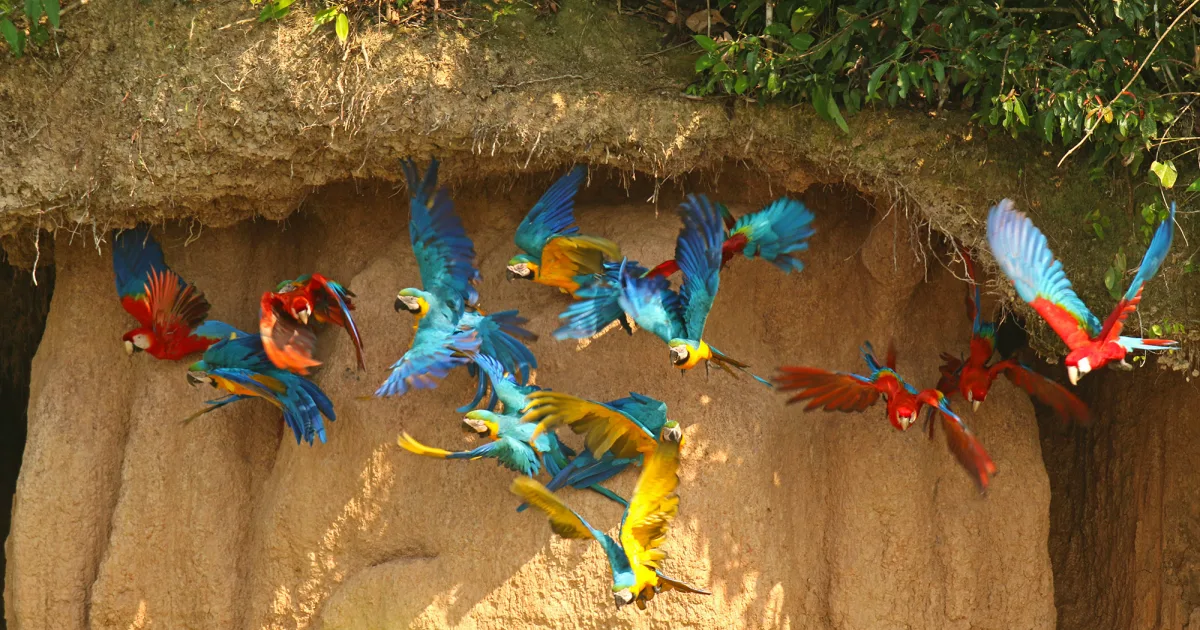
Tambopata National Reserve, located near the city of Puerto Maldonado, is more accessible than Manu and offers a vibrant and lively Amazonian experience. It is world-famous for its spectacular macaw clay licks, where hundreds of birds gather to consume clay.
Key Features:
- Macaw Clay Licks: Collpa Chuncho and Collpa Colorado are the largest and best-known, offering an unforgettable natural spectacle at dawn, when hundreds of red and green macaws, parrots, and parakeets descend to ingest mineral-rich clay.
- Sandoval Lake: A beautiful crescent-shaped lake, home to giant river otters, caimans, monkeys, and a wide variety of aquatic birds. It is accessed by a hike and a canoe ride.
- Diverse Fauna: In addition to macaws, you can observe capuchin monkeys, howler monkeys, squirrel monkeys, capybaras, black and white caimans, and a great diversity of birds.
- Access: The main entry point is Puerto Maldonado, which can be reached by commercial flights from Lima or Cusco. From there, transport to the lodges and the reserve is by boat along the Tambopata River.
💡 Local Guide Tip: If your time is limited, a 3-day, 2-night tour in Tambopata will allow you to experience the essentials, including a visit to a macaw clay lick and Sandoval Lake. Be prepared for an early start to witness the bird spectacle! Consider the Macaw Clay Lick and Sandoval Lake Tour: 3 Days / 2 Nights for a deep immersion.
Best Time to Visit Tambopata and Manu in 2026
The Peruvian Amazon rainforest has two well-defined seasons: the dry season and the wet season. Both offer unique experiences, and the "best" time will depend on your preferences.
| Feature | Dry Season (May - October) | Wet Season (November - April) |
|---|---|---|
| Climate | Less rain, sunny days, warm temperatures (25-35°C / 77-95°F). | Frequent and intense rains, high humidity, warm temperatures. |
| River Levels | Low, facilitating hikes on trails. | High, allowing exploration of more areas by boat. |
| Wildlife Viewing | Higher concentration of animals near water sources. | Greater activity of amphibians and insects. Birds in nesting season. |
| Mosquitoes | Present, but may be less abundant than in the wet season. | More abundant due to higher humidity. |
| Advantages | Easier for hiking, better conditions for photos. | More lush landscapes, fewer tourists, potentially lower prices. |
| Disadvantages | More tourists, some rivers may be less navigable. | Muddy trails, rains that can interrupt activities. |
💡 Local Guide Tip: If your priority is observing large mammals and birds at the clay licks, the dry season (May to October) usually offers the best conditions. However, the wet season reveals a more vibrant and less crowded jungle, ideal for botany enthusiasts and those seeking tranquility. Any time is good for adventure!
What to Pack for the Peruvian Amazon Rainforest? Your Essential List for Manu and Tambopata
Preparing your luggage for the Peruvian jungle is crucial for a comfortable and safe experience. Here's an essential list:
- Clothing:
- Long-sleeved shirts and long pants, lightweight and in neutral colors (green, khaki, gray) to protect you from the sun and insects.
- Quick-drying clothing (synthetic material or light cotton).
- A lightweight rain jacket or poncho.
- Swimsuit (if your lodge has a pool or for cooling off in safe rivers).
- Cotton or thin wool socks.
- Footwear:
- Waterproof and comfortable trekking boots (already broken in).
- Sandals or light shoes for the lodge.
- Rubber boots (many lodges provide them, but check).
- Personal Protection:
- Wide-brimmed hat or cap.
- Sunglasses.
- Insect repellent (with DEET or picaridin, at least 30%).
- High SPF sunscreen.
- Personal first-aid kit (pain relievers, anti-diarrhea medication, antihistamines, bandages, disinfectant, personal medications).
- Essential Gear:
- Daypack (for daily excursions).
- Large backpack (for the rest of your luggage, which will be transported by boat).
- Dry bags or waterproof covers to protect your electronic equipment and documents.
- Camera with extra batteries and memory cards.
- Binoculars (indispensable for bird and wildlife observation).
- Headlamp or flashlight with spare batteries.
- Reusable water bottle.
- Notebook and pen (to jot down your observations).
- Portable charger for electronic devices.
- Documents:
- Passport or ID (original and copy).
- Flight tickets and tour reservations.
- Vaccination card (especially yellow fever).
💡 Local Guide Tip: Remember that on trains to Machu Picchu (if you combine your trip), luggage is limited to 5 kg (11 lbs) per passenger. If you travel to the jungle from Cusco, we recommend leaving your main luggage at your hotel in Cusco (many offer this service for free) and taking only essentials in a daypack for your Amazonian adventure.
Key Preparations Before Your Amazonian Adventure
Good planning is key to fully enjoying your jungle trip.
- Vaccination: It is highly recommended to get vaccinated against yellow fever at least 10 days before traveling to the Amazon rainforest. Consult your doctor about other recommended vaccines such as tetanus, hepatitis A and B, and typhoid.
- Travel Insurance: Purchase travel insurance that covers medical emergencies, evacuation, and lost luggage. Medical care in remote areas can be limited and costly.
- Advance Bookings: Especially for Manu National Park, tours must be booked months in advance due to complex logistics and limited lodge availability. For Tambopata, it is also advisable to book in advance, especially during high season.
- Acclimatization (if coming from Cusco): If your Amazon rainforest trip begins after visiting Cusco (which is at 3,399 masl / 11,152 ft), make sure you have adequately acclimatized to the altitude before starting your descent into the jungle. Although the jungle is at low altitude, the sudden change can be exhausting.
- Tour Information: Make sure you understand the itinerary, what your tour includes and excludes, luggage policies, and safety measures.
Popular Routes and Circuits to Explore the Madre de Dios Jungle
The duration and type of jungle experience can vary considerably. Here are some common options:
- Short Tours (3-4 days): Ideal for those with limited time who want a quick immersion in the jungle. Generally focused on Tambopata National Reserve, including visits to macaw clay licks, trail hikes, and boat rides on Sandoval Lake. The Macaw Clay Lick and Sandoval Lake Tour: 3 Days / 2 Nights is an excellent example.
- Medium Tours (5-7 days): Allow for deeper exploration, combining Tambopata with more remote areas or dedicating more time to wildlife observation. In Manu, these tours usually venture into the Reserved Zone, offering greater chances of wildlife sightings.
- Long Expeditions (8+ days): For true adventurers and nature lovers, these expeditions delve into the depths of Manu National Park, exploring less visited areas and providing a more rustic and authentic experience, often with overnight stays in campsites.
💡 Local Guide Tip: Consider combining your Amazonian adventure with a trip to the Andean wonders. Many travelers choose to explore Cusco and Machu Picchu before or after the jungle. A Discovering Peru: Lima, Ica, Cusco, and Puno in 10 Days could be the perfect start to an adventure culminating in the Amazon.
Frequently Asked Questions (FAQs) about Traveling to Manu and Tambopata
Is it safe to travel to the Peruvian Amazon rainforest in 2026?
Yes, it is safe to travel to the tourist areas of Manu National Park and Tambopata National Reserve, especially if you do so with an authorized travel agency. The main concerns are mosquitoes and heat, but with adequate precautions (repellent, appropriate clothing, hydration) you will have no problems.
Do I need a guide to visit Manu or Tambopata?
Absolutely. Visiting these protected areas, especially Manu National Park, requires a certified local guide. Guides not only know the flora and fauna but also ensure your safety, help you interpret the environment, and allow you to maximize your sightings.
What is the average cost of a jungle tour?
Prices vary considerably depending on the tour duration, lodge comfort level, inclusion of flights, and the area to visit (Manu is generally more expensive due to its logistics). A 3-4 day tour to Tambopata can cost from $400-700 USD, while a 5-7 day expedition to Manu can exceed $1,000-2,000 USD. It is important to check what each package includes.
Is Inca Expedition an authorized travel agency for jungle tours?
Yes, Inca Expedition is a LOCAL AUTHORIZED TRAVEL AND TOURISM AGENCY BY DIRCETUR CUSCO. We have the experience and knowledge to organize your trip to the Amazon rainforest, ensuring your experience is safe, enriching, and respectful of the environment.
Can I see jaguars in Manu or Tambopata?
Jaguar sightings are possible but extremely rare and require a lot of luck and patience. They are very elusive animals. The chances are higher in Manu's Reserved Zone and in certain areas of Tambopata, but there is never a guarantee.
What impact does my visit have on the jungle?
Responsible and sustainable tourism is vital. By choosing a travel agency that works with local communities, respects protected area regulations, and promotes ecological practices, your visit directly contributes to the conservation of the jungle and the well-being of its inhabitants.
The Amazon rainforest of Madre de Dios is a life-changing destination. Its sounds, its colors, its immense biodiversity, and the feeling of being in such a pristine and wild place are experiences that are etched into the soul. In 2026, the opportunity to explore Manu National Park and Tambopata National Reserve awaits you, promising an unforgettable adventure. At Inca Expedition, our team of local guides in Cusco is always ready to advise you if you wish to experience this adventure with personalized accompaniment, managing every detail to make your expedition to the Peruvian Amazon rainforest as magical as you imagine. Get ready for the adventure of a lifetime!
Frequently Asked Questions
What is the best time to travel to Cusco and Machu Picchu?
The dry season (from May to October) offers sunny days and a lower chance of rain.
How to prepare for the altitude in Cusco?
Rest on the first day, drink plenty of water, drink coca tea, and avoid heavy meals.
How far in advance should I book for the 2026 season?
For Machu Picchu and the Inca Trail in 2026, it is recommended to book 2 to 5 months in advance due to the strict ticket limit.
What clothes to wear for hikes in the Andes?
Layered clothing: thermals, waterproof windbreaker, trekking shoes with good grip, and sun protection.